See our August 2018 Newsletter

May 2019
It’s that time of year when millions of women and men farmers in some parts of the world are planting their crops and, in other parts, they are harvesting. Their work is long and hard. Whether planting or harvesting, seeds are the soul of these sacred events. The Seeds, Soil & Culture Fund honors these farmers, their hard work, and their seeds as best we can. Please visit our updated website to learn about more than 40 projects around the world with seeds, soil and culture at the heart of all the good work happening. Yet, it’s fair to ask, what is Seeds, Soil & Culture trying to do?

It is this. How we think and talk about seeds and soil reflects how we view the natural world, including our bodies because of the food we eat. In many parts of the world, farmers’ reverence for seeds and soil is heard, felt or seen in language, stories and ceremony. People who view seeds and soil as living beings rather than commodities have maintained a vital connection to the natural world. Their values of respect, reciprocity, harmony, a sense of what is sacred, and gratitude for what is given and shared are so needed in our world today. These values live in the hearts and minds of millions of women and men farmers around the world, yet we barely hear them, or know their work.

Here are four stories about farming by Indigenous Peoples, three communities in North America and one in Central Asia. We invite you to read about their work. The stories are about Braiding the Sacred throughout the US; Hopi Tutskwa Permaculture Institute and Black Mesa Water Coalition in Arizona; and Agency for Development Initiatives in Kyrgyzstan. While each of us hears stories in different ways, in these stories I hear reverence for the souls who walked and worked the land before our time. I hear respect for the unseen beings who guide us how to live on the land. Through learning about the work and dedication of these food growers, whether planting or harvesting now, we can hear their voices clearly.
 

New York State in the U.S. is amply blessed with gorgeous lakes and landscapes. The region’s beauty is a gift born from the grinding power of glaciers. Slowly the glaciers retreated to the north 18,000 years ago, depositing a wealth of soil and rock at each stop. Between then and now, the People of the Hills, the Onondaga Nation, made these undulating lands their home. A year ago, I walked on them too.

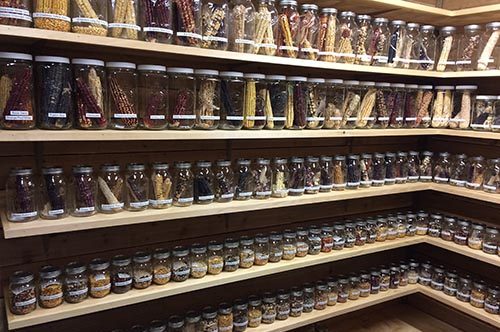
I went to visit Angela Ferguson, Farm Crew Supervisor of the Onondaga Nation. Angela gave me a tour of the Farm’s seed conservatory. The conservatory is like the hardwood forests, deep valleys, and steep flanks that surround it; simply inspiring. It was cool and foggy that day in April but the modest, well-built seed conservatory was warm and bright with life inside, a comforting space shared by seeds and people. I’ve been fortunate to visit seed conservatories the world over. They are all wonderful but the Onondaga Nation Farm conservatory is very special, brimming with positivity, confidence, reverence, and love.

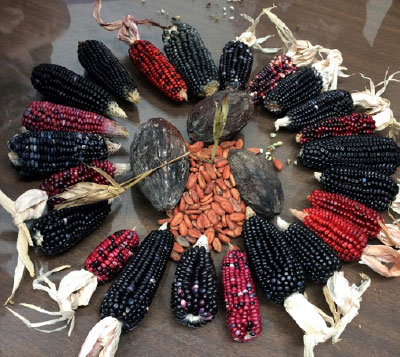
Prior to my arrival, Angela had been visiting Oklahoma to learn about the heritage seeds of the late Carl Barnes, a prolific Cherokee native seed keeper in recent times. While there, Angela was gifted several dozen corn varieties in small samples. She knew them all by heart. Over two hours, Angela showed me the seeds one-by-one, carefully explaining their features and names, and having fun doing so. With us were Farm workers and volunteers sorting and cataloguing seeds, and Lea Zeise, the Eastern Region Technical Assistance Specialist of the Intertribal Agriculture Council (IAC). IAC is fiscal sponsor of a project called Braiding the Sacred, a network of Indigenous corn keepers and corn cultures across Turtle Island working to steward sacred ancestral seed varieties. About 100 or so Braiding the Sacred growers are reproducing some varieties to ensure there is enough seed stock to share and create redundancy.

Braiding the Sacred is also organizing Rematriation Gatherings of Native corn growers and cultural leaders of the Mother Nations. During the Gatherings, Native men and women seed growers, keepers, and cultural leaders share their ancestral seeds and meals, and their knowledge, stories, and songs about Corn Culture. At the Gatherings, in talking circles, they share their perspectives on which seeds to rematriate, a term commonly understood to mean “returning the sacred to the Mother.” The Braiding the Sacred coordinating committee makes the determination on which seed varieties to rematriate based on trusted contacts within the First Nations and the viability of the seed stock being considered. With Rematriation Gatherings as a cultural key, Braiding the Sacred is opening and safeguarding seed keeping knowledge throughout Turtle Island, one Native variety at a time. As Braiding the Sacred explains:

“We who are made of corn have been called to assemble in unity among our diverse Corn Nations of the four directions. From our ancestral maize come the lessons for our future. The current decimation of corn is intricately related to the mainstream disconnection of the spiritual from our sacred maize. The vibrant diversity represented in our Corn Cultures has resisted extermination for hundreds of years. We must draw upon the strength of ancestral corn teachings. It is time to plant.”

When the Seeds, Soil & Culture Fund began, I visited the village of Kykotsmovi on the Hopi Indian Reservation in northern Arizona. Kykotsmovi sits in a semi-arid landscape of distant views and hills of jutting rock, bathed in golden light and flecked with bushes and trees. Lilian Hill, the Executive Director of Hopi Tutskwa Permaculture Institute (HTPI), took me to the mesa communities, ancient villages perched above the plains, where the original Hopi people resided and where many still do.

Throughout history, Hopi people farmed the lands below the mesas, growing heirloom corn, beans, squash, melons, pumpkins, apples, peaches, apricots, pears, and medicinal plants. Their health and well-being depended on deep and intimate knowledge of their land and relationship with the spiritual forces of nature, following the teachings of Hopi ancestors and elders. Hopi agrarians developed farming practices that nurtured the natural world and people over many generations. Traditional foods that sustained Hopi people for thousands of years, such as sacred blue corn, are spiritual nourishment, enabling Hopi women and men to better understand their purpose in life and to grow as human beings. Put simply, food is the basis of Hopi philosophy, and farming brings Hopi values into action.

Hopi agriculture relies on rain and runoff water. It’s dry farming, a traditional art that Hopi people deeply revere. Dry farming is rigorous and labor-intensive and is still performed primarily by hand. Hopi farmers practice floodwater farming to irrigate their fields. Manual irrigation on terraces with buckets or gravity-fed irrigation using conduits from artesian springs are used as well. Through dry farming, Hopi farmers enter into a spiritual covenant with Màasaw, guardian and protector of the world. Dry farming requires patience, humility, hard work, and a heart of prayer. Crops are raised in a loving manner by Hopi farmers as if the seeds and plants are their children. Seeds are sacred to Hopi farmers. Hopi seed keepers are elders, often women, who safeguard knowledge of Hopi ceremonies to protect the seeds.

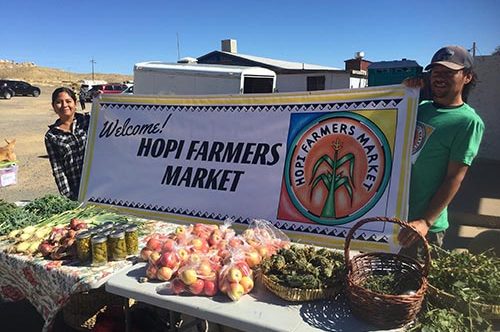
HTPI organizes Na’ya (working together) parties to regenerate farms, restore water sources and increase the role of traditional food in the local economy. It supports a food cooperative to improve community nutrition and sponsors a Farmers Market to increase local community access to traditional Hopi Foods and build the capacity of Hopi Farmers. HTPI’s Hopi Youth Permaculture Program teaches young people 12-18 years old about Hopi agroecology via on-farm learning from crop growers, orchard keepers, bee keepers, herbalists, water keepers, seed stewards, and building experts. Older youth learn specialized knowledge about soil and water restoration, plant propagation, seed biology, and environmental science. They restore artesian springs and traditional fields, prune and care for fruit orchards, build earthwork structures, create pollinator habitats, and teach culinary techniques guided by local cooks and chefs.

In the tradition of caring for and respecting the natural environment for past, present, and future generations, HTPI helps Hopi people today learn skills and gain experience in healthy ecological living while vigilantly honoring Hopi cultural ways. HTPI strives to strengthen the viability and conservation of Hopi food systems and its cultural values of selfless cooperation and helping others for the good of all.

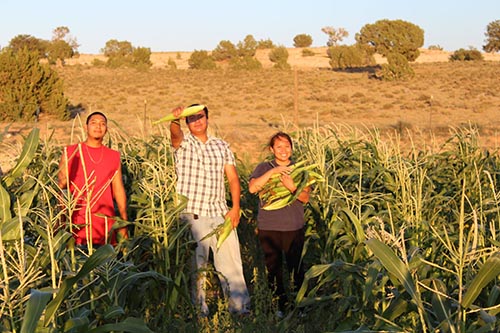
I first met Roberto Nutlouis at Tsyunhehkw^, or Life Sustenance, the name of the 83-acre organic farm of the Oneida Nation of Wisconsin. There we harvested corn together, a field activity of the National Food Sovereignty Summit. Roberto is Navajo, however, and was visiting from northern Arizona where he is Restorative Economy Program Director of Black Mesa Water Coalition (BMWC). As we filled our burlap sacks with ears of Oneida yellow corn, Roberto told me about BMWC’s work to restore traditional corn fields and water systems managed by Navajo Clan Mothers on their lands. So, last year on a cold March day of hail, rain, and sun, I visited Roberto on the vast Navajo Reservation. He took me around the land. We dipped into valleys of fields and pasture lying in yellow soil then back into the surrounding hills. The peaceful land masks the atrocity of Navajo wealth lost during the time of Roberto’s grandparents, when scores of sheep were massacred upon U.S. federal orders. Yet Roberto grew up on the Reservation with indomitable spirit, and he is devoted to regenerating traditional ways of Navajo life and sustenance.

Over 20 years, Black Mesa Water Coalition (BMWC) has grown from a small, student-managed group to an established NGO focused on food sovereignty, energy independence, and restorative economics to better the lives of local Indigenous communities. As part of its work on the Navajo Reservation today, BMWC is helping reinvigorate the traditional farming system that depends on seasonal monsoon floodwaters to irrigate cropland. In brief, the surface runoff waters from the nearby hills bring plant matter and animal manure into fields. When slowed and captured, the waters replenish the soil. Allowing surface runoff to percolate is essential for the next growing season and the long term by recharging groundwater. Livestock are let into fields after harvest, and their manure is dug into the soil the following Spring. Native plants are left to grow after August, providing winter food for livestock and aerating the soil with their roots.

Navajo People, or Diné, developed their specialized dry land farming methods over many centuries, and grounded them in Sa’ah Naagháí Bi’ke Hózhóón, the natural order of life. To Diné, seeds are living beings, sacred gifts passed from generation to generation, and they sow seeds adapted to local conditions. They formed social systems to organize farming activities, all with deep reverence for Mother Earth. Diné believe that Mother Earth gave them four branches of knowledge, all of which are relevant to food systems today. Bik’ehgo Da’iinaani teaches to revere all life. Nihigaal teaches to share opportunities that are equitable for everyone. A’ha’ana’oo’niil teaches to promote and contribute to social cohesion. Haa’ayiih doo hodilzin teaches that nature is sacred, a true source of healing, and reciprocal in spirit.

BMWC honors these values in its work to heal the world by reaffirming the power rooted in Indigenous teachings to maintain the relationship of people to the sacred Mother Earth, protect Mother Earth’s ability to provide for the well-being of all creation, and transition to culturally-based, ecologically-restorative economies centered around healing. These ideals, embedded in BMWC’s work and nurtured by leaders like Roberto Nutlouis, pertain to all food systems where seeds, soil, and culture intentionally converge.

Kyrgyzstan’s climate is ideal for growing vegetables and seeds. Before the Soviet Union disintegrated, Kyrgyzstan was one of its main sources of food production. When the Soviet Union’s political economy crashed 30 years ago, the massive cooperative farms that supplied its commodity crops for export were split into 400,000 small farms by the Kyrgyzstan government. So, today in Krygystan, the Agency for Development Initiatives (ADI) is reviving small farm food production, providing an opportunity for rural Kyrgyz women to grow heirloom vegetables, revive traditional agricultural knowledge, and earn income.

ADI’s work is based on the cultural values of Kyrgyzstan people, invoking the spirit of living harmoniously with nature. And the revival of local seeds in Kyrgyzstan is more than a technical matter; it’s biocultural. Seeds have always been a focus of cultural and spiritual identity for Kyrgyz people. They are symbols of life, connection with the universe, and prosperity. Seeds are ozok, the core, the foundation for healthy food, especially cereal grains, which are often consumed with dairy products, a well-balanced diet for living at high altitudes. Local seeds are the basis of traditional medicine, folk kitchens for healthy food, and the secrets of healing with herbs. Seeds and their crops are cultural touchstones for Kyrgyz people.

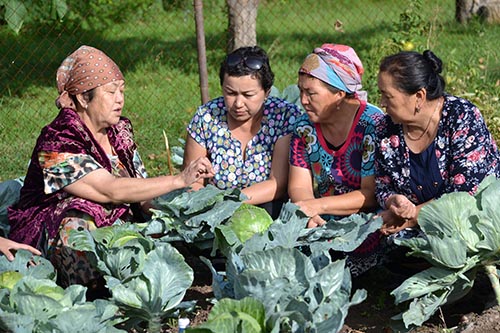
In that spirit, ADI manages the Dyikan Muras (Farmers’ Heritage) Seed-Savers Network, created by Kyrgyz women vegetable farmers five years ago. To the women of Dyikan Muras, heritage seeds are sacred beings and symbols of their relation to nature. Their work with seed growers in three regions of Kyrgyzstan – Talas, Batken, and Chui – is a cultural matter and a biological one. Taken together, the biocultural basis for their work is to grow the highest quality heritage vegetables and seeds in strict accordance with current rigorous standards in the Kyrgyz Republic and consistent with their cosmological beliefs.

Dyikan Muras Seed-Savers Network honors seeds as sacred keys to all life. The women care for seeds as symbols of Indigenous Kyrgyz culture which values peace throughout society. For the women of Dyikan Muras, local seeds carry values, energy, and spiritual identity. If the seeds are lost, so is some part of people’s harmony with the world. By saving and growing seeds, Dyikan Muras women reproduce their natural environment and what it provides for daily life, and thus they reproduce themselves in a deep sense. Because seeds for the Kyrgyz people are a way to transfer sacred energy to human beings, plants have sacred status. To this point, Dyikan Muras women believe that respecting, protecting, and increasing biocultural seed diversity can awaken people’s aspirations for harmonious life and basic happiness.

Putting their beliefs into practice, the Dyikan Muras (Farmers’ Heritage) Seed-Savers Network, will reach scores of rural women over the next few years, managing productive and profitable small-scale vegetable farming operations (one-half acre on average). They are building greenhouses and establishing plots for reproducing seeds and for practical research on seed selection. The network of experienced and new seed growers visit one another to share what they know and have learned. Via the network, ADI promotes holistic revitalization of heritage seeds; increases awareness among all Kyrgyz people about the relationship between spirit, health, the environment, and well-being; and nurtures self-determination by local communities in their actions to revive heritage seeds and Kyrgyzstan’s rural economy.